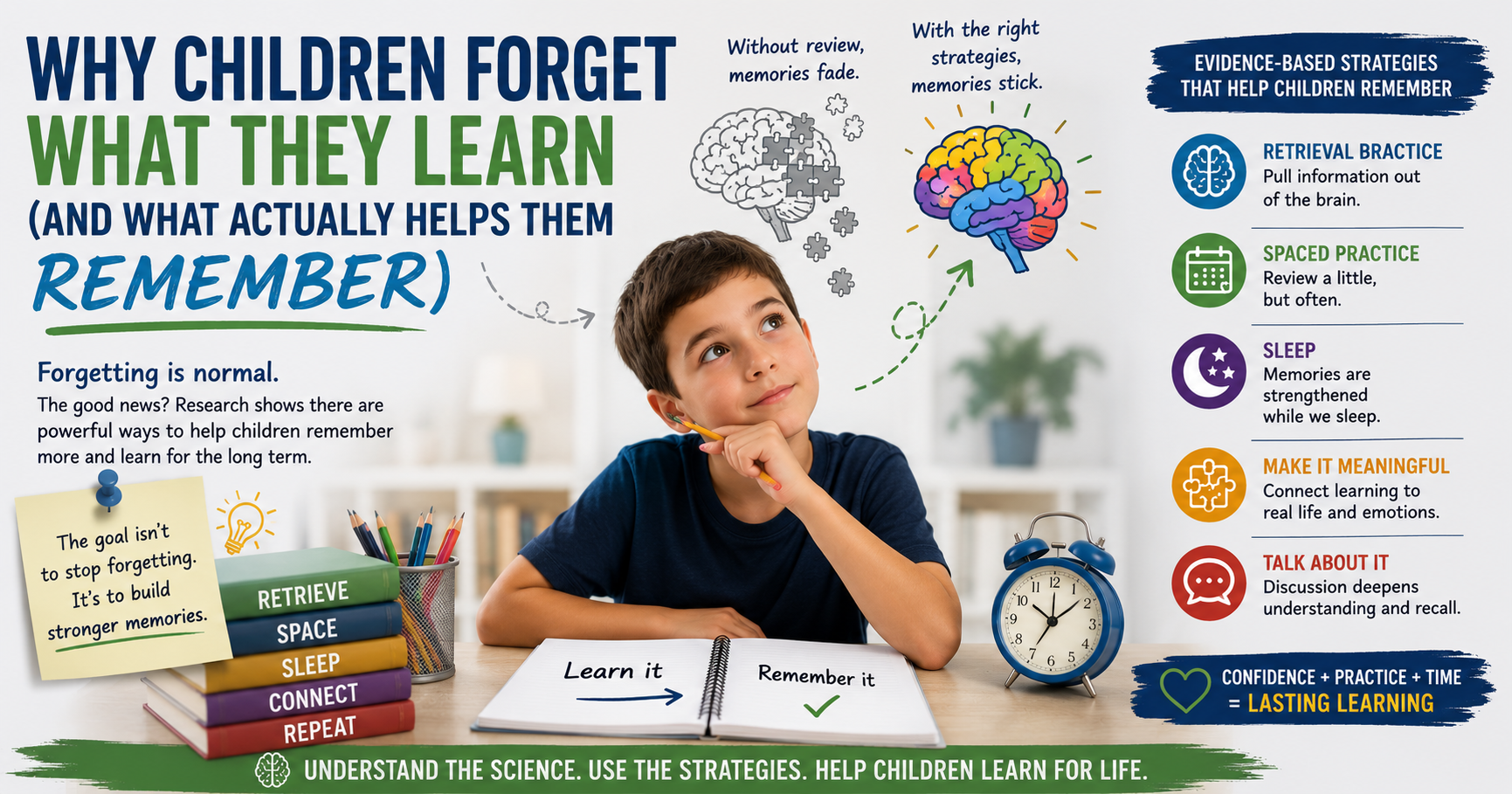
A child confidently answers every question during a lesson. They seem to understand the concept perfectly. The next day, however, much of that learning appears to have vanished. Many parents and educators experience this frustrating cycle. A child masters their times tables one week, struggles the next. They spell words correctly on Monday and forget them by Friday. They appear to understand a reading strategy during guided practice but cannot apply it independently later.
This often leads adults to wonder:
“Was my child paying attention?”
“Do they need more practice?”
“Why do they keep forgetting?”
The reality is that forgetting is not necessarily a sign that learning has failed. In fact, modern research suggests that forgetting is a normal and expected part of the learning process. Understanding why children forget what they learn can help parents and educators support memory more effectively and create learning experiences that last.
The Surprising Truth: Forgetting Is Normal
One of the most important findings in cognitive science is that forgetting is a natural function of the brain. Our brains receive enormous amounts of information every day. If we remembered everything perfectly, we would struggle to identify what is important. Instead, the brain constantly filters information. Researchers estimate that people encounter thousands of pieces of information daily, yet only a small proportion becomes part of long-term memory. The question is not:
“Why do children forget?”
The question is:
“What helps the brain decide to keep information?”
Understanding this shift changes how we think about learning.
The Forgetting Curve: What Research Reveals
One of the most influential studies on memory was conducted by German psychologist Hermann Ebbinghaus in the late nineteenth century. Through a series of experiments, Ebbinghaus discovered what is now known as the Forgetting Curve. His findings showed that people forget information rapidly after first learning it.
Without review or retrieval:
Significant forgetting occurs within days.
Memory continues to decline over time.
Information becomes increasingly difficult to access.
However, each time information is revisited, recalled, or practised, the memory becomes stronger and forgetting slows. More than a century later, modern research continues to support this principle. The implication for parents and educators is powerful:
Learning something once is rarely enough.
Children need opportunities to revisit learning repeatedly over time.
Learning Is Not the Same as Remembering
One of the biggest misconceptions in education is the belief that understanding automatically leads to remembering. A child may understand a maths concept during a lesson because the teacher is guiding them. A child may read a text successfully because support is available. A child may spell a word correctly because they have just practised it. In these situations, performance appears strong. However, performance during learning is not the same as memory. Researchers Robert and Elizabeth Bjork have highlighted the distinction between performance and learning. Children can appear successful in the moment while still failing to retain information long term. True learning is demonstrated when information can be retrieved later without support. This is why children sometimes appear to “know” something one day and forget it the next. The memory was never fully established.
How Memories Are Formed
Memory formation generally involves three stages:
Encoding
Information enters the brain through attention and experience. If attention is weak, encoding is often weak.
Storage
The brain begins organising information for longer-term retention. Connections are formed between new knowledge and existing knowledge.
Retrieval
Information is recalled when needed. Each successful retrieval strengthens the memory. This means that remembering is not simply evidence of learning. Remembering actually helps create learning. The act of retrieval strengthens neural pathways and makes future recall more likely.
Why Re-reading Is Less Effective Than We Think
Many children prepare for tests by repeatedly reading notes or textbooks. While this feels productive, research suggests it is often less effective than active recall. When children re-read material, they become familiar with it. Familiarity can create the illusion of learning. However, recognising information is very different from retrieving it independently. Educational psychologist John Dunlosky identified retrieval practice as one of the most effective evidence-based learning strategies available. Rather than simply reading information again, children benefit from:
Self-quizzing
Flashcards
Explaining concepts aloud
Practice questions
Brain dumps
These activities require the brain to retrieve information, strengthening memory in the process.
The Power of Retrieval Practice
Retrieval practice is one of the most researched learning strategies in cognitive science. Instead of putting information back into the brain, retrieval practice asks children to pull information out.
Examples include:
Recalling yesterday’s lesson
Explaining a concept without notes
Answering questions from memory
Completing quizzes
Research consistently shows that retrieval improves long-term retention more effectively than passive review. This is sometimes referred to as the “testing effect.” Importantly, retrieval practice is not about assessment. It is about strengthening memory. Every successful retrieval acts like a workout for the brain.
Why Spaced Practice Beats Cramming
Many children attempt to learn large amounts of information in a single session. This approach often creates short-term gains but poor long-term retention. Research on spaced practice demonstrates that spreading learning over time produces stronger memories. Instead of: Two hours on one day Try: Twenty minutes across six days. Spacing introduces manageable forgetting between sessions. Although retrieval becomes slightly harder, the brain works more actively to reconstruct the memory. This effort strengthens learning. Researchers refer to this as a “desirable difficulty.” Learning feels harder but becomes more durable.
Sleep: The Hidden Learning Superpower
Many parents focus on homework, revision, and practice. Far fewer think about sleep. Yet sleep plays a critical role in memory consolidation. During sleep, the brain processes and strengthens newly acquired information. Research has repeatedly found links between sleep quality and academic performance. Children who regularly obtain sufficient sleep tend to demonstrate:
Better memory
Improved concentration
Stronger problem-solving skills
Greater emotional regulation
Learning does not stop when children fall asleep. In many ways, some of the most important memory work happens overnight.
Why Emotion Matters in Learning
Children remember some experiences for years while forgetting others almost immediately. One reason is emotion. Research suggests emotionally meaningful experiences are more likely to be remembered.
This helps explain why children often remember:
Exciting school trips
Hands-on projects
Personal achievements
Stories
Real-life experiences
More easily than isolated facts. Learning becomes more memorable when it is connected to:
Curiosity
Meaning
Relevance
Personal experiences
The brain is constantly asking: “Does this matter?” When the answer is yes, retention improves.
The Role of Cognitive Load
Children do not have unlimited working memory. Cognitive Load Theory, developed by John Sweller, suggests that learning becomes more difficult when too much information is presented simultaneously. Working memory has limited capacity. When children become overwhelmed:
Information is harder to process.
Learning becomes less efficient.
Retention decreases.
This is why effective teaching often involves:
Breaking information into smaller steps
Providing worked examples
Reducing distractions
Building knowledge gradually
Children remember more when their brains are not overloaded.
Why Confidence Influences Memory
Memory is not purely cognitive. It is also emotional. Children who experience repeated failure often become hesitant learners. They may stop attempting retrieval because they fear being wrong. However, confidence encourages engagement. When children feel safe making mistakes, they are more likely to:
Attempt difficult questions
Participate in discussions
Practise retrieval
Persist through challenges
At Quality First Education, we often say: Confidence comes before independence.
Children are more likely to remember what they learn when they are willing to engage fully in the learning process.
Practical Strategies That Help Children Remember
If you want to improve retention, focus on evidence-informed approaches.
1. Encourage Retrieval Practice
Ask:
“What do you remember about yesterday’s lesson?”
rather than
“Let’s read it again.”
2. Use Spaced Review
Revisit learning after:
One day
Three days
One week
One month
3. Prioritise Sleep
Protect sleep routines wherever possible.
4. Connect Learning to Real Life
Help children see why information matters.
5. Break Learning Into Manageable Chunks
Avoid overwhelming working memory.
6. Encourage Discussion
Talking about learning strengthens understanding and recall.
7. Celebrate Effort
A growth mindset encourages persistence and engagement.
Forgetting can feel frustrating. Parents may worry that learning has not happened. Teachers may wonder whether lessons have been effective. Children may feel discouraged when they cannot immediately remember something. However, forgetting is not evidence of failure. It is part of how memory works. The goal is not to prevent forgetting entirely. The goal is to strengthen learning through retrieval, spacing, meaningful experiences, sufficient sleep, and effective teaching. When we understand how memory develops, we stop asking:
“Why does my child keep forgetting?”
and begin asking:
“What experiences will help this learning stick?”
Learning is not about what a child can remember today. It is about what they can still remember weeks, months, and years from now.