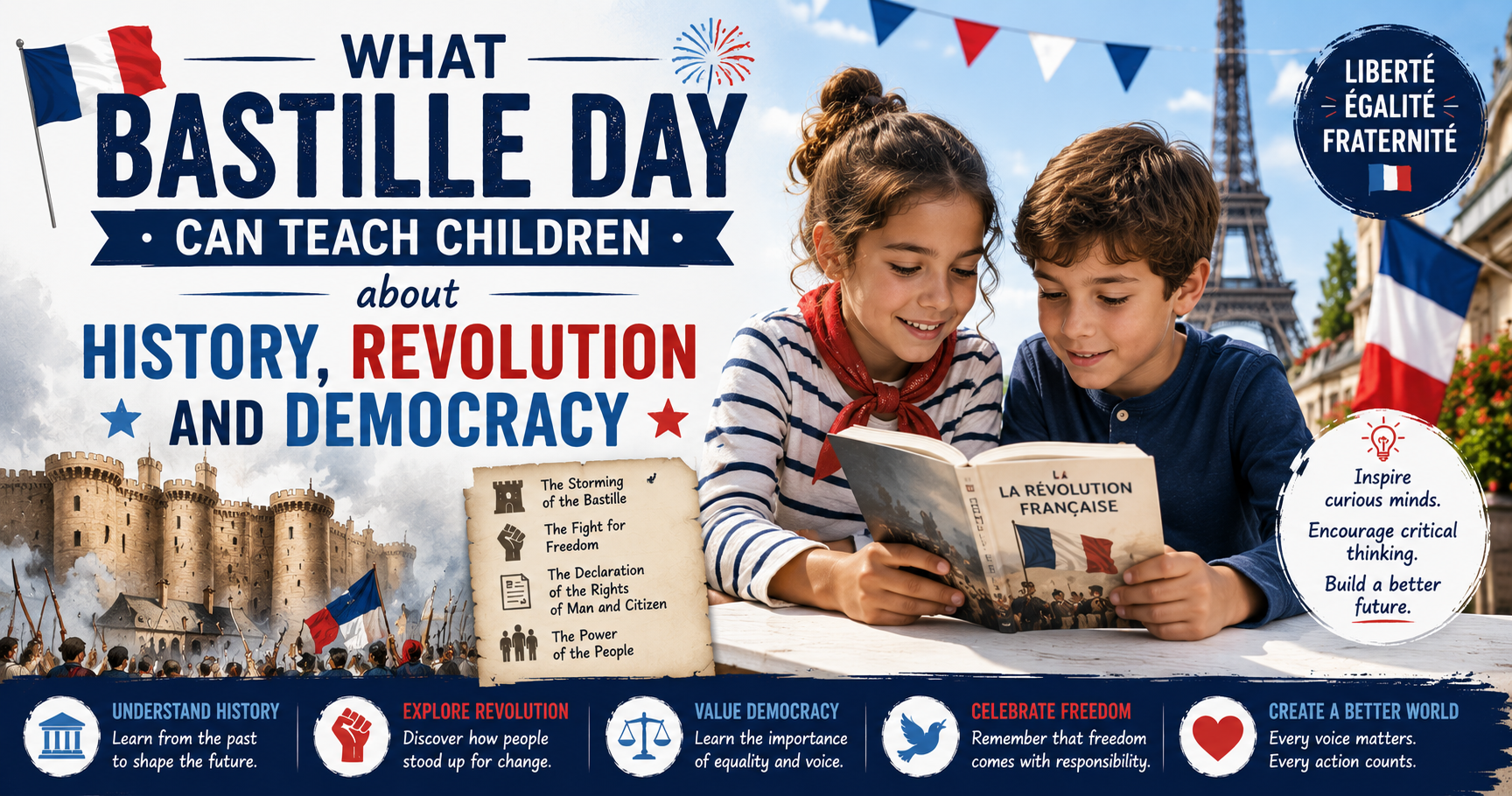
Every year on 14th July, France celebrates Bastille Day, one of the country’s most important national holidays. Across France, people gather for parades, fireworks, concerts, and community celebrations to commemorate a turning point in French history. For many children, Bastille Day may simply appear to be France’s version of Independence Day. However, behind the celebrations lies a fascinating story about power, inequality, revolution, citizenship, and democracy.
For homeschoolers, home educators, and families, Bastille Day provides an opportunity to explore history while encouraging children to think critically about fairness, leadership, rights, and how societies change over time. Understanding the events of the French Revolution not only helps children learn about the past but also provides important lessons about democracy and the freedoms many people enjoy today.
What Is Bastille Day?
Bastille Day, known in France as La Fête Nationale, is celebrated on 14th July each year. The date marks the Storming of the Bastille, which took place in Paris on 14th July 1789. The Bastille was a fortress and prison that had become a symbol of royal power and oppression. When revolutionaries stormed the prison, it became one of the defining moments of the French Revolution.
Today, Bastille Day symbolises:
Freedom
Citizenship
National unity
Democracy
The rights of ordinary people
Although the prison itself held only a small number of prisoners at the time, the event represented something much larger: a challenge to a system that many people believed was unfair.
France Before the Revolution
To understand why the French Revolution happened, children first need to understand what life was like before it. In the late eighteenth century, France was ruled by King Louis XVI. French society was divided into three groups known as the Three Estates.
The First Estate
The clergy, including church leaders.
The Second Estate
The nobility, including wealthy landowners and aristocrats.
The Third Estate
Everyone else.
This included:
Farmers
Labourers
Craftspeople
Shopkeepers
Professionals
The Third Estate made up the vast majority of the population. However, they had the least power and often paid the most taxes. Many ordinary people struggled with poverty, rising food prices, and a lack of political influence. This growing inequality contributed to widespread frustration.
Why Did the French Revolution Begin?
Historians identify several key causes of the French Revolution.
Economic Problems
France faced serious financial difficulties. Wars, government spending, and poor harvests had created significant debt. At the same time, bread prices rose dramatically, making it difficult for many families to afford food.
Inequality
Many people believed the system was unfair. The wealthiest groups often paid fewer taxes than poorer citizens.
New Ideas
During the Enlightenment, philosophers began promoting ideas about:
Liberty
Equality
Human rights
Representative government
Thinkers such as John Locke, Voltaire, and Jean-Jacques Rousseau questioned traditional systems of power and encouraged people to think differently about government.
Lack of Representation
Many ordinary citizens felt they had little say in decisions affecting their lives. This growing dissatisfaction eventually led to calls for reform and change.
The Storming of the Bastille
On 14th July 1789, a large crowd gathered in Paris. Fearing conflict with royal forces and seeking weapons, revolutionaries targeted the Bastille. After hours of fighting, the fortress was captured. The event quickly became a symbol of resistance against absolute monarchy. Although relatively small in military terms, the storming carried enormous symbolic importance. For many people, it represented hope that change was possible. The event spread revolutionary enthusiasm across France and became one of the defining moments of the French Revolution.
What Happened After the Bastille?
The French Revolution continued for many years. During this period:
The monarchy was eventually abolished.
New political systems were created.
Citizens demanded greater rights.
France experienced significant social and political change.
The revolution was complex and often violent. While it achieved important reforms, it also included periods of conflict and instability. This reminds us that historical change is rarely simple.
What Can Children Learn About Democracy?
One of the most important reasons to study Bastille Day is that it helps children understand democracy.
Today, many people can:
Vote in elections
Express their opinions
Participate in government
Access legal protections
These rights did not emerge automatically. Throughout history, people have often campaigned for greater representation and fairness. Learning about the French Revolution helps children understand how democratic systems developed and why participation matters.
What Can Children Learn About Fairness?
Children often have a strong sense of fairness. When they hear that some groups paid fewer taxes while others struggled to survive, they immediately begin asking questions. Historical events provide opportunities to discuss:
Equality
Justice
Responsibility
Privilege
Rights
These conversations help children think critically about both the past and the present.
What Can Children Learn About Revolution?
The word “revolution” can sound dramatic. Simply explained, a revolution is a major change in how a country is governed or organised. The French Revolution demonstrates how societies can change when large numbers of people believe a system is no longer working.
Children can explore:
Why people seek change
How change happens
The risks involved
The consequences of major decisions
These discussions develop historical reasoning and critical thinking skills.
Comparing the French Revolution and Other Historical Events
Bastille Day provides an excellent opportunity to compare historical events around the world. Children might compare:
The French Revolution
The American Revolution
The Glorious Revolution in Britain
Independence movements in other countries
Questions to consider include:
What caused each event?
What changes occurred?
What rights were people seeking?
How successful were the movements?
Comparisons help children recognise patterns across history.
Activities for Children
Create a Timeline
Research key events from the French Revolution and place them in chronological order.
Design a Revolutionary Newspaper
Write a newspaper report describing the storming of the Bastille.
Debate Fairness
Discuss whether the Three Estates system was fair.
Compare Governments
Explore differences between monarchy and democracy.
Research Historical Figures
Investigate:
King Louis XVI
Marie Antoinette
Maximilien Robespierre
Marquis de Lafayette
Create a Bastille Day Fact File
Record key facts, dates, and historical significance.
Why History Still Matters Today
Some children wonder why they need to learn about events that happened hundreds of years ago. It is because history helps us understand the world we live in now. Many ideas that shape modern societies - including democracy, citizenship, voting rights, and equality before the law - have been influenced by historical events such as the French Revolution. When children study history, they learn more than dates and facts. They learn how societies develop, how people respond to challenges, and how ideas can change the world.
Bastille Day is far more than a French national celebration. It marks a pivotal moment in world history and provides valuable opportunities for children to explore democracy, fairness, citizenship, and social change. By learning about the French Revolution, children begin to understand that history is not simply a collection of events from the past. It is a story of people, ideas, struggles, and decisions that continue to influence the world today. Whether through research, discussion, creative projects, or historical comparisons, Bastille Day offers meaningful learning opportunities that extend far beyond a single day of celebration.
At Quality First Education, we believe that studying history helps children become thoughtful, informed, and curious learners. Understanding the past helps us make sense of the present - and inspires us to shape a better future.