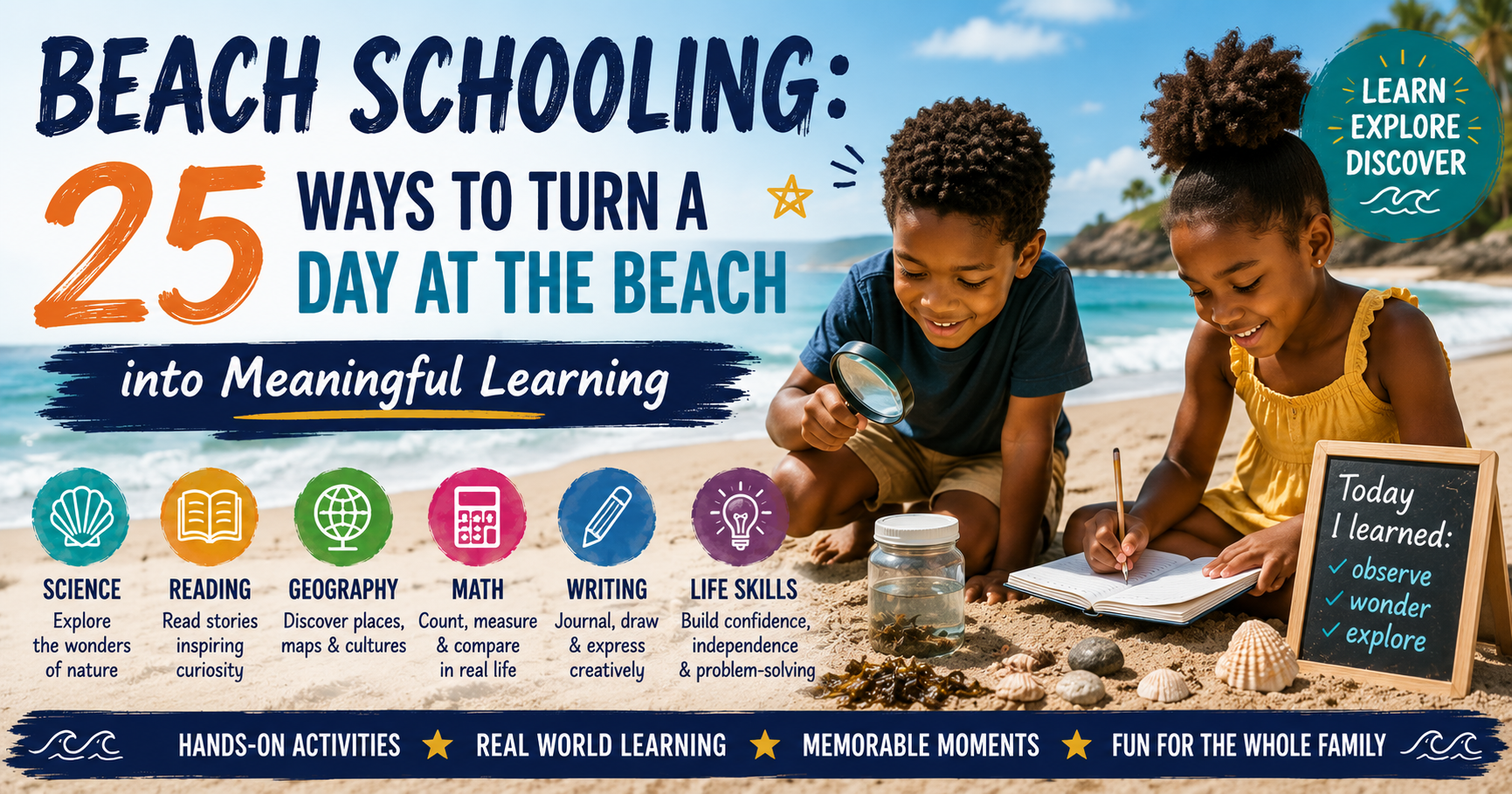
A trip to the beach is a day of relaxation, fresh air, and fun. However, for homeschoolers, home educators, and curious families, the beach can also become one of the richest learning environments imaginable. From science and geography to maths, literacy, art, and environmental awareness, the beach offers countless opportunities for hands-on learning that simply cannot be replicated in a classroom. Children naturally learn best when they are engaged, curious, and actively exploring the world around them. The beach provides opportunities to observe, investigate, question, create, and discover - all while enjoying the outdoors. Whether you’re planning a dedicated educational beach day or simply looking to add learning opportunities to your family outing, these 25 beach schooling activities can help transform a day by the sea into a memorable learning experience.
Why Beach Schooling Works
Research consistently shows that experiential learning helps children develop deeper understanding and stronger long-term memory. When children engage multiple senses, connect learning to real experiences, and actively investigate their surroundings, they are more likely to remember what they learn. Beach environments naturally encourage:
Scientific observation
Critical thinking
Creativity
Problem-solving
Communication skills
Environmental awareness
Physical activity
Most importantly, children often don’t realise they’re learning because they’re too busy exploring.
Science Activities
1. Investigate Tides
Observe the shoreline throughout the day. Ask:
Is the water moving closer or further away?
What changes can you see?
Why do tides happen?
Older children can research how the Moon’s gravitational pull affects tides.
2. Create a Beach Habitat Survey
Look for evidence of living things. Record:
Seabirds
Shellfish
Crabs
Seaweed
Insects
Discuss how different organisms survive in coastal environments.
3. Explore Adaptations
Choose a beach creature and investigate:
What does it eat?
How does it stay safe?
How does it survive changing tides?
This develops scientific enquiry and research skills.
4. Build a Mini Ecosystem Diagram
Draw the food chain found at your local beach. Include:
Producers
Consumers
Predators
Discuss how all living things are connected.
5. Conduct a Floating and Sinking Investigation
Collect natural materials.
Predict whether each item will float or sink before testing.
Discuss density and buoyancy.
Geography Activities
6. Create a Coastal Landforms Hunt
Can children identify:
Cliffs
Sand dunes
Bays
Headlands
Rock pools
Take photographs and create a field guide.
7. Draw a Beach Map
Encourage children to create a simple map of the area. Include:
Compass directions
Key landmarks
Symbols
A map key 8. Investigate Erosion
Look for signs of coastal erosion. Discuss:
hat causes erosi
How do communities protect coastlines?
What happens if erosion continues?
9. Compare Beaches Around the World
Research beaches in: Australia, Hawaii, South Africa, The Maldives, Scotland
Compare climate, wildlife, and geography.10. Follow a Coastal Trail
Use a map to navigate a walking route. Develop map-reading and navigation skills.
Maths Activities
11. Shell Sorting and Graphing
Collect shells and sort them by:
Size
Shape
Colour
Create tally charts and bar graphs.
12. Measure Beach Features
Estimate and measure:
Rock lengths
Driftwood pieces
Sandcastle heights
Practise measurement skills.
13. Calculate Wave Frequency
Cout how many waves reach the shore in one minute. Compare findings at different times.
14. Create Symmetrical Sand Art
Investigate symmetry through beach art. Challenge children to create symmetrical patterns.
15. Estimate and Count
Estimate the number of pebbles or shells in a container before counting. Discuss estimation strategies.
Literacy Activities
16. Beach Nature Journal
Encourage children to record:
Observations
Sketches
New vocabulary
QuestionsThis supports descriptive writing and scientific recording.
17. Write a Seaside Story
Use the beach as inspiration for creative writing.
Prompts might include:
A mysterious message in a bottle
A hidden cave
An unusual sea creature
18. Create a Beach Poetry Collection
Try:
Acrostic poems
Haiku
Shape poetry
Free verse
19. Build Vocabulary
Challenge children to collect and define new words.
Examples: Tide, Dune, Coastline, Erosion, Habitat
20. Conduct an Interview
Interview a family member about their favourite beach memory.
Develop speaking and listening skills.
Art and Creativity Activities
21. Create Natural Beach Art
Arrange shells, pebbles, seaweed, and driftwood into temporary artworks.
Discuss the work of environmental artists such as Andy Goldsworthy.
22. Sketch the Landscape
Observe the coastline and create a detailed drawing.
Focus on observation skills rather than artistic perfection.
23. Design the Ultimate Sandcastle
Add criteria such as: Height, Stability, Creativity
Introduce elements of engineering and design.
Environmental Learning Activities
24. Conduct a Beach Clean-Up
Provide gloves and bags.
Discuss: Marine pollution, Plastic waste, Conservation
Children often gain a deeper understanding of environmental responsibility through direct action.
25. Become a Coastal Conservationist
Research local conservation efforts.
Ask:
What wildlife lives here?
What threats exist?
How can people help?
Create a conservation poster to share with others.
One of the greatest advantages of beach schooling is that it demonstrates an important truth: Learning does not only happen at a desk.
Some of the most meaningful educational experiences occur when children are exploring, questioning, creating, and interacting with the real world. A day at the beach can become a science laboratory, geography field trip, maths investigation, writing workshop, art studio, and environmental classroom all at once. When children connect learning to authentic experiences, they often develop stronger understanding, deeper curiosity, and greater confidence.
The beach is far more than a place to paddle, build sandcastles, and enjoy ice cream. It is a living classroom filled with opportunities for discovery. Whether you’re homeschooling, home educating, supporting summer learning, or simply looking for meaningful family activities, beach schooling can help children develop knowledge, skills, and memories that last far beyond the day itself. The next time you head to the coast, take a notebook, ask questions, encourage curiosity, and embrace the learning opportunities all around you. Because sometimes the best classroom has no walls at all.