When many people think about learning, they picture textbooks, worksheets, writing tasks, and structured lessons. Yet some of the most powerful learning opportunities can come disguised as play.
A child carefully solving a Sudoku puzzle.
A family working together to complete a jigsaw.
A group of children competing in a strategy board game.
A young learner attempting to crack a riddle or brain teaser.
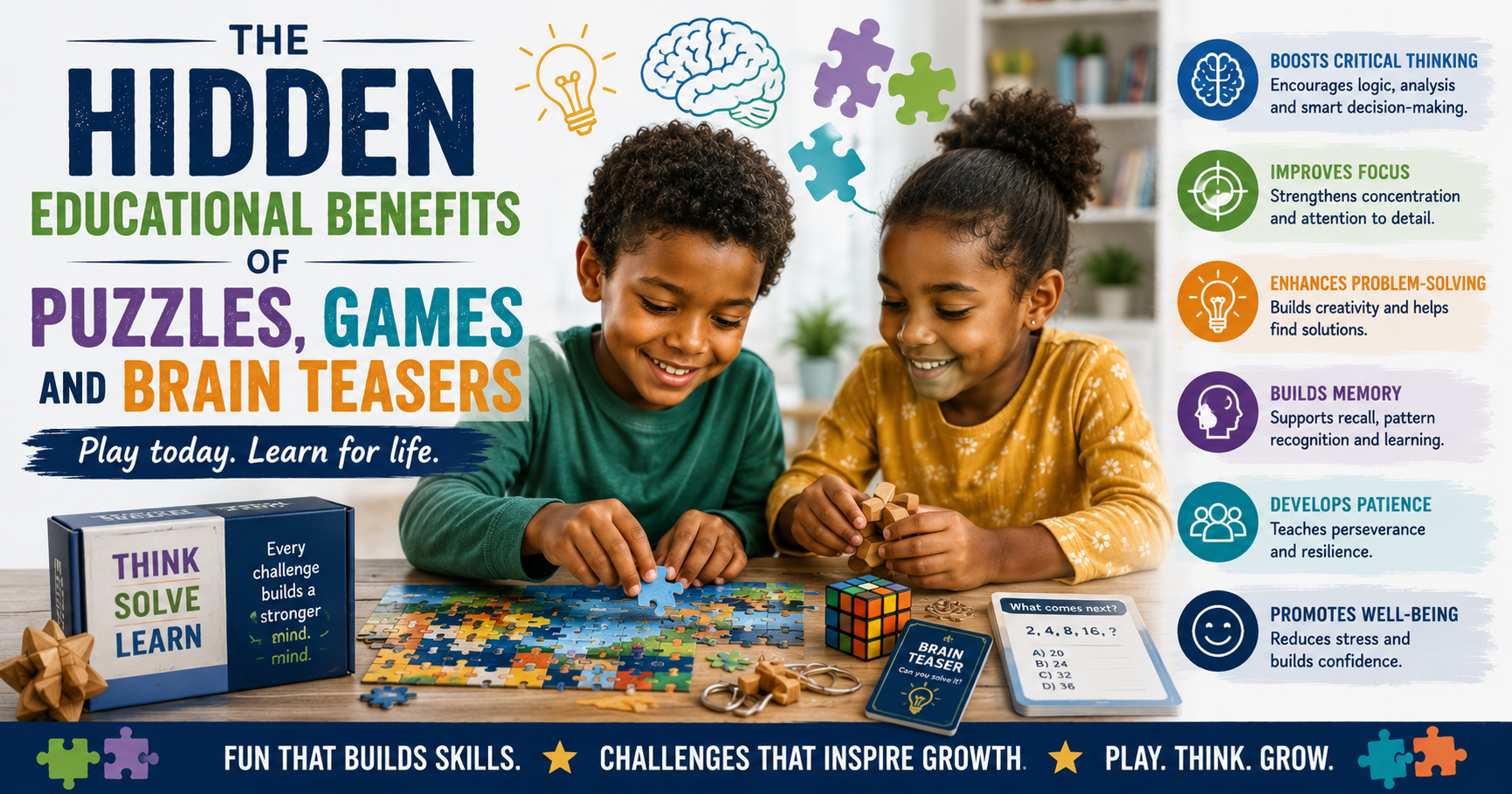
At first glance, these activities may simply appear entertaining. However, research suggests that puzzles, games, and brain teasers can support a wide range of cognitive, social, and academic skills that contribute to long-term learning success. Far from being “just games,” these activities help children develop critical thinking, problem-solving abilities, memory, attention, resilience, and flexible thinking. In an age where educational success is increasingly linked to creativity, adaptability, and complex reasoning, puzzles and games deserve far more recognition than they often receive.
Why Play Matters for Learning
Children are naturally wired to learn through exploration and play. Developmental psychologists have long recognised that play provides opportunities for children to test ideas, solve problems, take risks, and build understanding in meaningful ways. Unlike traditional tasks that may have one correct answer, many games and puzzles require children to:
Experiment
Evaluate options
Adapt strategies
Learn from mistakes
Persist through challenges
These are exactly the kinds of thinking skills that support lifelong learning. Research consistently shows that children learn more effectively when they are actively engaged and emotionally invested in a task. Games and puzzles naturally create this engagement.
Building Problem-Solving Skills
One of the greatest educational benefits of puzzles is their ability to strengthen problem-solving. Every puzzle presents a challenge. The child must determine:
What is the goal?
What information is available?
What strategies might work?
What should I try next?
This process mirrors the thinking required in many academic subjects. Whether solving a maths problem, interpreting a reading comprehension question, conducting a science investigation, or writing an essay, children rely on similar problem-solving processes. Regular exposure to puzzles helps children become more comfortable tackling unfamiliar challenges. Instead of immediately giving up when something feels difficult, they begin to develop confidence in finding solutions.
Strengthening Working Memory
Working memory plays a vital role in learning. It allows children to temporarily hold and manipulate information while completing a task. Children use working memory when they:
Follow instructions
Solve maths problems
Read complex sentences
Write independently
Participate in discussions
Many puzzles naturally exercise working memory. For example:
1. Sudoku
Children must remember number placements while considering future possibilities.
2. Memory Matching Games
Players actively hold information in mind while searching for pairs.
3. Logic Problems
Children track multiple pieces of information simultaneously. Regular practice can help children become more efficient at managing information mentally.
Developing Critical Thinking
Critical thinking involves analysing information, evaluating evidence, and making reasoned decisions. Many games require children to think beyond simple recall.
They must:
Compare options
Predict outcomes
Assess risks
Make strategic choices
Consider a simple board game. A child may need to decide whether to make a safe move or take a calculated risk. To do this effectively, they must evaluate available information and anticipate possible consequences. These are valuable thinking skills that extend far beyond game play.
Improving Attention and Concentration
Modern children face more distractions than ever before. Notifications, screens, background noise, and fast-paced entertainment constantly compete for attention. Many puzzles encourage sustained concentration. Children often become deeply focused while:
Completing jigsaws
Solving word searches
Working through mazes
Cracking riddles
Playing strategy games
These activities help strengthen attention control and persistence. The ability to maintain focus on a challenging task is strongly linked to academic success.
Encouraging Persistence and Resilience
Not every puzzle is solved immediately. Not every game is won. This is precisely why they are so valuable. Children learn that success often requires:
Patience
Effort
Strategy adjustments
Multiple attempts
Psychologist Carol Dweck’s research on growth mindset highlights the importance of viewing challenges as opportunities for growth rather than evidence of failure. Puzzles provide frequent opportunities to experience productive struggle. Children learn that mistakes are not something to avoid. Instead, mistakes become useful information that guides future attempts.
Supporting Mathematical Thinking
Many people associate maths with calculations. However, mathematics is fundamentally about patterns, relationships, logic, and reasoning. Many puzzles strengthen these underlying skills. Examples include:
1. Sudoku
Develops logical reasoning and pattern recognition.
2. Tangrams
Strengthen spatial awareness and geometry skills.
3. Number Puzzles
Support numerical reasoning.
4. Strategy Games
Encourage planning, sequencing, and mathematical thinking. Children often develop mathematical confidence when learning occurs in enjoyable and meaningful contexts.
Enhancing Literacy Skills
Puzzles can also support reading and language development.
1. Word Searches
Strengthen spelling recognition.
2. Crosswords
Develop vocabulary knowledge.
3. Riddles
Encourage inference and interpretation.
4. Word Games
Expand language skills and verbal reasoning. These activities expose children to new words while making literacy practice enjoyable.
Strengthening Executive Function Skills
Executive functions are the brain’s management system. They include:
Planning
Organisation
Self-control
Flexible thinking
Monitoring progress
Strong executive function skills are linked to academic achievement and long-term success. Many games naturally develop these abilities. Children often need to:
Plan ahead
Monitor outcomes
Adapt strategies
Follow rules
Manage impulses
These skills transfer to learning environments and everyday life.
Developing Flexible Thinking
Life rarely follows a perfect plan. When circumstances change, children need to adapt. Flexible thinking helps children:
Consider alternative solutions
Adjust strategies
Respond to unexpected challenges
Games frequently require players to change their approach when situations evolve. This develops cognitive flexibility and encourages adaptability.
Social and Emotional Benefits
Many games provide opportunities for social learning. Children practise:
Turn-taking
Cooperation
Communication
Conflict resolution
Empathy
Learning to win graciously and lose respectfully are important life skills. Family game nights can also strengthen relationships while providing valuable learning experiences.
The Science Behind Brain Challenges
Research in cognitive psychology suggests that learning is strengthened when children actively retrieve information, solve problems, and engage in effortful thinking. Activities that challenge the brain promote the development of neural connections. When children tackle puzzles, they are not simply filling time. They are engaging in cognitive processes that support learning across multiple domains. The key is not whether an activity looks academic. The key is whether it requires meaningful thinking.
Great Puzzles and Games for Different Ages
Younger Children
Shape sorters
Matching games
Simple jigsaws
Pattern blocks
Picture dominoes
Primary-Aged Children
Sudoku
Word searches
Tangrams
Logic puzzles
Connect Four
Guess Who?
Chess beginners’ sets
Older Children
Chess
Escape room puzzles
Crosswords
Strategy board games
Cryptic clues
Advanced logic challenges
The best puzzle is often one that feels challenging but achievable.
How Families Can Encourage Brain-Based Play
Simple strategies include:
Make Games Accessible
Join In
Focus on Effort
Encourage Discussion
Ask:
How did you solve that?
What strategy did you use?
What might you try next time?
These conversations strengthen metacognitive thinking.
Embrace Challenge
Avoid immediately providing answers. Allow children time to think, experiment, and struggle productively.
Puzzles, games, and brain teasers may look like simple entertainment, but beneath the surface they are powerful learning tools. They develop problem-solving, memory, concentration, resilience, critical thinking, executive function, and creativity—all skills that support academic success and lifelong learning. Most importantly, they show children that learning can be enjoyable. When children become absorbed in solving a puzzle, cracking a code, or developing a winning strategy, they are doing far more than passing the time. They are strengthening the very skills that help them become confident, capable, independent learners.
At Quality First Education, we believe that meaningful learning does not only happen through worksheets and lessons. Some of the most valuable learning occurs when children are curious, challenged, engaged, and having fun. Puzzles, games, and brain teasers provide the perfect opportunity for all four.