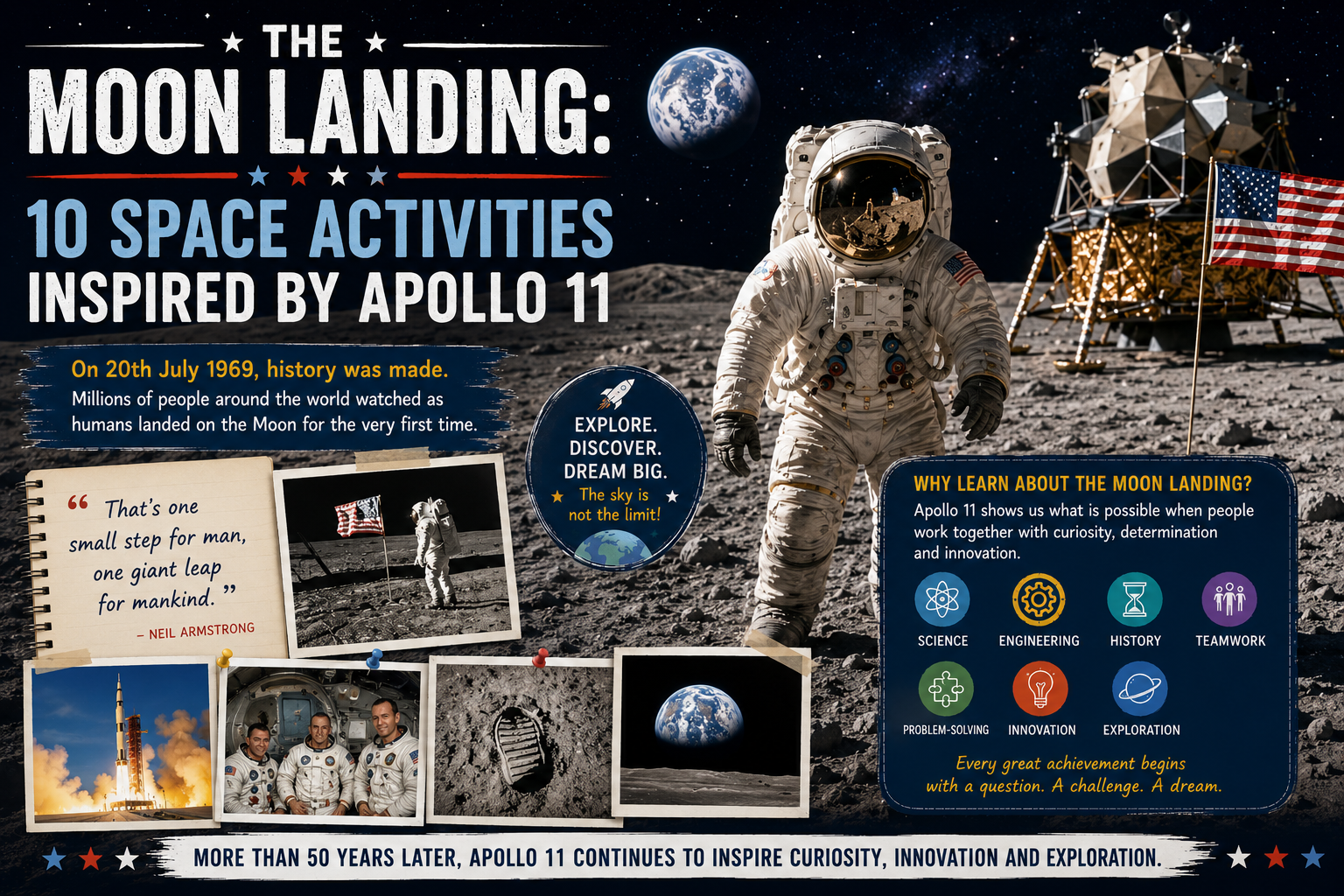
On 20th July 1969, history was made.
Millions of people around the world watched as humans landed on the Moon for the very first time. When astronaut Neil Armstrong stepped onto the lunar surface and spoke the famous words, “That’s one small step for man, one giant leap for mankind,” it marked one of humanity’s greatest achievements. More than fifty years later, the Apollo 11 mission continues to inspire curiosity, innovation, and exploration. For children, the Moon Landing provides a fantastic opportunity to learn about science, technology, engineering, geography, history, and space exploration. Whether you’re homeschooling, home educating, supporting summer learning, or simply looking for engaging family activities, these Apollo 11-inspired ideas can help bring one of history’s most remarkable events to life.
What Was Apollo 11?
Apollo 11 was the space mission that successfully landed the first humans on the Moon. The mission launched from Florida on 16th July 1969 and carried three astronauts:
Neil Armstrong
Buzz Aldrin
Michael Collins
Four days later, Armstrong and Aldrin landed on the Moon in the Lunar Module Eagle, while Collins remained in orbit aboard the Command Module Columbia. The mission demonstrated what could be achieved through science, engineering, teamwork, and determination. Today, Apollo 11 remains one of the most important events in human history.
Why Learn About the Moon Landing?
The Moon Landing helps children explore:
Space science
Engineering
Problem-solving
History
Human achievement
Innovation
Perseverance
It also encourages children to ask one of the most important questions in education:
“What is possible when people work together to solve difficult problems?”
1. Build a Moon Landing Timeline
Create a timeline showing key events in the Apollo 11 mission. Include:
Launch Day
Journey to the Moon
Lunar Orbit
Moon Landing
Moonwalk
Return to Earth
Children can add illustrations and facts to each stage.
Skills Developed
Chronology
Historical understanding
Research skills
2. Design Your Own Rocket
Challenge children to design a rocket capable of travelling to the Moon. Consider:
Size
Fuel
Crew capacity
Safety features
Older children can research the Saturn V rocket that carried Apollo 11 into space.
Skills Developed
Engineering
Design thinking
Creativity
3. Create a Moon Crater Investigation
Fill a tray with flour and cover it with cocoa powder or sand. Drop different objects from varying heights.
Observe:
Crater size
Crater shape
Impact patterns
Discuss how meteorites create craters on the Moon.
Skills Developed
Scientific enquiry
Observation
Data collection
4. Write a Newspaper Report About Apollo 11
Imagine you are a journalist reporting on the Moon Landing in 1969.
Include:
Headlines
Interviews
Eye-witness accounts
Mission facts
Children can create their own front page.
Skills Developed
Writing
Research
Historical understanding
5. Investigate Moon Phases
Observe the Moon over several weeks. Record:
Shape changes
Position in the sky
Dates
Create a Moon phase journal. Discuss why the Moon appears different throughout the month.
Skills Developed
Scientific observation
Recording data
Astronomy
6. Build a Lunar Habitat
If humans lived permanently on the Moon, what would they need? Challenge children to design:
Living quarters
Food production systems
Water supplies
Energy sources
Use cardboard, LEGO, recycled materials, or digital drawing tools.
Skills Developed
Engineering
Problem-solving
Critical thinking
7. Measure Moon Gravity
Research how gravity differs on Earth and the Moon. The Moon’s gravity is approximately one-sixth of Earth’s.
Ask:
How would jumping change?
How would sports change?
How would daily life change?
Children can compare movements and make predictions.
Skills Developed
Scientific reasoning
Mathematical thinking
8. Create a Space Fact File
Research one aspect of space exploration. Topics might include:
Neil Armstrong
Buzz Aldrin
Saturn V
The International Space Station
Artemis missions
Mars exploration
Present findings in a fact file or poster.
Skills Developed
Research
Information organisation
Presentation skills
9. Build a Straw Rocket
Create simple rockets using paper and drinking straws. Experiment with:
Fin shapes
Rocket length
Nose cone designs
Measure flight distances and compare results.
Skills Developed
Engineering
Investigation
Measurement
10. Imagine the Future of Space Exploration
Apollo 11 was only the beginning. Ask children:
Should humans return to the Moon?
Should we build lunar bases?
Will people live on Mars?
What might space travel look like in 100 years?
Children can write stories, create posters, or design future spacecraft.
Skills Developed
Creativity
Critical thinking
Future-focused learning
What Apollo 11 Teaches Children
The Moon Landing is not simply a story about rockets and astronauts. It is a story about curiosity, determination, innovation, and teamwork.
The mission required:
Scientists
Engineers
Mathematicians
Technicians
Pilots
Problem-solvers
Thousands of people worked together to achieve what once seemed impossible. Great achievements often begin with a question. A challenge. A dream. Or a problem waiting to be solved.
Bringing Space Learning Across the Curriculum
The Moon Landing naturally connects to multiple subjects:
Science
Gravity
Forces
Space
Materials
Maths
Measurement
Data handling
Distance calculations
Geography
Earth and Moon systems
Mapping
Planetary features
History
The Space Race
Apollo programme
Technological advancement
English
Reports
Diaries
Persuasive writing
Creative stories
This makes Apollo 11 an excellent cross-curricular learning topic.
More than half a century after Apollo 11 landed on the Moon, the mission continues to capture children’s imaginations. The Moon Landing reminds us that exploration, curiosity, and innovation can lead to extraordinary achievements. Whether children are building rockets, investigating craters, designing lunar habitats, or imagining future missions to Mars, space-themed learning provides endless opportunities for discovery. As we commemorate the anniversary of Apollo 11, we celebrate not only a historic achievement but also the spirit of curiosity that drives learning itself. After all, every great discovery begins with a simple question:
“What if?”